
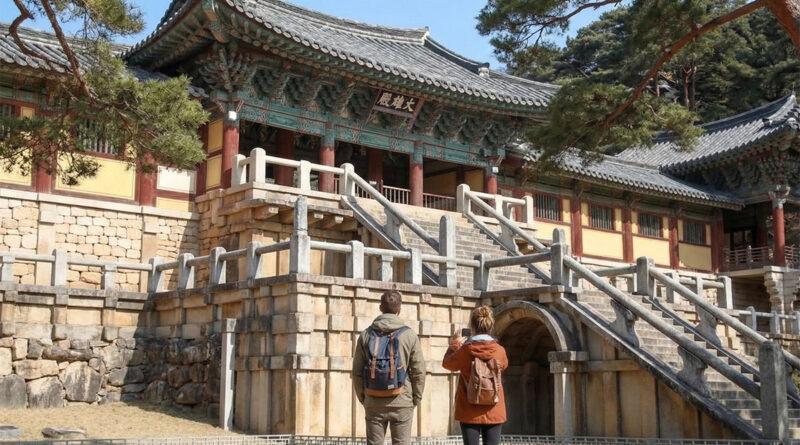
Bulguksa: Discover the Golden Age of Ancient Korea: From Seoul to Gyeongju

Bulguksa Temple: A Journey into the Golden Age of Korean Buddhism
Bulguksa, located in Gyeongju, is not just a temple; it’s a living museum and a masterpiece that represents the artistic peak of the Silla Kingdom. For travelers seeking a deep dive into Korean history and spiritual beauty, this UNESCO World Heritage Site is an absolute must-visit.
The Story of Bulguksa: Engineering a Land of Buddha
Built in the mid-8th century (around 751 AD), Bulguksa was conceived as a physical manifestation of the Buddha’s Pure Land (Utopia) on Earth. Every part of the temple, from the placement of stones to the choice of colors, was designed with profound cosmological and spiritual meaning. The architecture is renowned for its seamless blend of natural environment and artificial structure, making it one of Korea’s most historically significant buildings.
Must-See Highlights
Here is where you can witness the incredible skill of Silla’s artisans:
-
Dabotap (Pagoda of Many Treasures): Unlike many other simple stone structures, this 10-meter pagoda is a marvel of intricate stone-carving, featuring unique lion statues and a detailed, complex form. It represents the Buddha appearing in the sky, demonstrating that his truth is universal.
-
Seokgatap (Sakyamuni Pagoda): Standing opposite Dabotap, this pagoda is the epitome of classic, symmetrical Korean pagoda design. It symbolizes the Buddha sitting quietly on Earth, achieving enlightenment. Together, they represent a perfect balance.
-
Daeungjeon (The Hall of Great Enlightenment): The main hall that enshrines the Sakyamuni Buddha. Its colorful Dancheong (traditional Korean multi-colored painting) patterns are breathtakingly detailed.
-
The Stone Bridges (Cheongungyo & Baegungyo): These “Bridges of Blue and White Clouds” symbolize the transition from the secular world to the spiritual world of Buddha. The craftsmanship of the arched supports and steps is extraordinary for its time.
Nearby Extra: Seokguram Grotto
Just a short shuttle ride (or a peaceful hike) away from Bulguksa is Seokguram Grotto. Inside, a colossal, serene Buddha statue sits overlooking the East Sea. It is a man-made cave temple and a rival masterpiece of Bulguksa. Make sure to visit both!
How to Get to Gyeongju from Seoul
| Method | Route | Duration |
| KTX (Train) | Seoul Station → Gyeongju Station | Approx. 2 hrs |
| Express Bus | Seoul Express Bus Terminal → Gyeongju Terminal | Approx. 3.5 hrs |
💡 Final Pro Tip: Upon arriving at Gyeongju KTX Station, take bus 700 or 711 directly to Bulguksa. From the Gyeongju Intercity/Express Bus Terminal, take bus 10 or 11!
#Bulguksa #Gyeongju #VisitKorea #KoreaTravel #UNESCOWorldHeritage #KoreanHistory #BuddhistTemple #TravelGram #KoreaTrip #ExploreGyeongju #TempleStay #SillaKingdom #HistoricKorea #불국사 #경주여행 #석굴암