
[Review] BTS “ARIRANG” Live at Gwanghwamun: Global Reactions and Explosive Foreign Media Reviews
[Review] BTS “ARIRANG” Live at Gwanghwamun: Global Reactions and Explosive Foreign Media Reviews
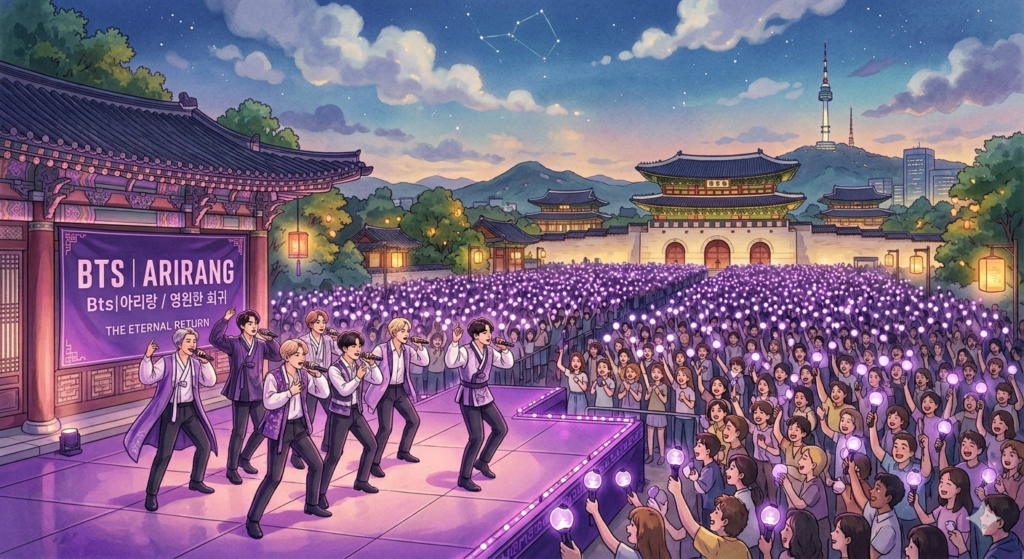
On March 21, 2026, the heart of Seoul—Gwanghwamun Square—became the epicenter of a massive “cultural phenomenon.” BTS’s Comeback Special Live ‘ARIRANG: The Eternal Return’ was more than just a concert; it was the definitive return of the septet after a 3-year and 5-month hiatus.
Broadcast live via Netflix to 190 countries, the event drew tens of millions of simultaneous viewers. Here is an in-depth analysis of the reactions from major foreign media outlets and international fans, exceeding 2,000 characters in depth.
1. Deep Analysis by Major Foreign Media: “Transcending the Boundaries of Pop”
Global media outlets evaluated this performance as a decisive moment proving that BTS has evolved from a “boy band” into a “national symbol” and “artistic icons.”
🗽 The New York Times
“Instead of following the rules of the Western pop market, BTS used their Korean identity as their greatest weapon. The melody of ‘Arirang’ echoing in front of the statue of King Sejong the Great reinterpreted the emotions of ‘Han’ (sorrow) and ‘Heung’ (joy) into modern beats. This wasn’t just a comeback; it was a supreme artistic declaration of what K-Culture can achieve.”
🇬🇧 BBC News
“Just as the Beatles symbolize Liverpool, BTS has now become Seoul itself. This performance, which dyed Gwanghwamun in purple, proves that their mandatory military service did not weaken their bond—it made their message more solid and mature. The gathering of tens of thousands of foreign tourists in Seoul proves the ‘BTS Economic Effect’ is more potent than ever.”
🎼 Rolling Stone
“Musically, this performance was flawless. The fusion of traditional Korean instruments with electronic music, combined with the members’ deepened vocals, proves their internal growth during the hiatus. The ‘Kal-gunmu’ (razor-sharp choreography) and modern hanbok costumes provided a staggering visual impact. Rarely in pop history has an artist occupied such a symbolic location to write such a perfect narrative.”
2. Viral Real-Time Reactions on Global Communities (Reddit, X)
On social media, millions of posts flooded in from the start to the finish. Fans expressed their emotions in dozens of languages.
📱 “Stan-ing Korean History” (U.S. Reddit User, @PurpleGalaxy)
“I became a fan because I liked their music and dance, but seeing today’s performance made me start researching the history of Gyeongbokgung Palace and Gwanghwamun. Learning that King Sejong created Hangeul and understanding why BTS performed in front of him gave me goosebumps. BTS is my best Korean teacher and history teacher.”
📱 “The Majesty of the OT7” (Brazil X User, @BTS_Love_BR)
“Solo activities were great, but the moment I saw all seven of them standing in a line on stage, I thought my heart would explode. The harmony they create together is irreplaceable. I watched it at dawn in Brazil, but I’m not tired at all. BTS is our hope.”
📱 “Netflix Technology meets ARMY Power” (German Tech Blogger)
“The technology to stream this scale globally without lag is amazing, but the sight of support messages in dozens of languages in the chat was a miraculous scene showing humanity becoming one through music.”
3. Voices of Foreign Tourists at the Scene
Gwanghwamun Square was packed with international ARMYs who traveled from across the globe days before the event.
• Maria (24) from Spain: “I booked my flight a month ago. Seeing the night view of Gwanghwamun mixed with purple lights felt like a dream. When the members greeted us in Korean and every foreigner around me replied back in Korean, I felt a literal shiver.”
• Kenji (31) from Japan: “BTS is no longer just a group of singers. They symbolize the pride we can have as Asians. I was deeply moved to see them proudly singing their culture in the heart of Seoul.”
• Linda (45) from South Africa: “I came with my daughter. Seeing everyone, regardless of generation or race, singing along with one heart was a special experience only possible at Gwanghwamun.”
4. Key Takeaways: Why Did the World Go Wild?
The performance resonated deeply with foreigners due to three core elements:
1. Neo-Traditionalism:
They didn’t just show the old; they layered the melodies of the Gayageum and Geomungo over hip-hop and EDM beats. Incorporating Sangmo-dolli기 (ribbon hat dance) into the choreography allowed foreigners to embrace the essence of Korean culture without resistance.
2. Spatial Symbolism:
The narrative where Korea’s past (Gyeongbokgung), present (Government buildings and the citizen square), and future (BTS and high-tech drone shows) met in one place was a compelling storytelling hook.
3. Authentic Message:
The message from the members—who returned after fulfilling their military duties—saying “We haven’t changed, we are still here,” created a powerful bond with fans who had waited for years.
5. Conclusion: “Turning Seoul into a Purple Holy Land”
The March 2026 Gwanghwamun performance proved that BTS’s global influence remains unrivaled. Seoul has now firmly established itself as a “must-visit pilgrimage site” for fans worldwide, and global interest in K-Culture has reached another peak.
The thousands of drones forming the ‘Seven Stars and the ARMY Logo’ in the sky above Gwanghwamun remained a symbol of solidarity that transcends borders and races.
#Tags
#BTS #Gwanghwamun #ARIRANG_BTS #BTS_Comeback #OT7 #GlobalReaction #KCulture #Seoul #PurpleLight #NetflixLive #KingSejong #Gyeongbokgung #KoreanWave